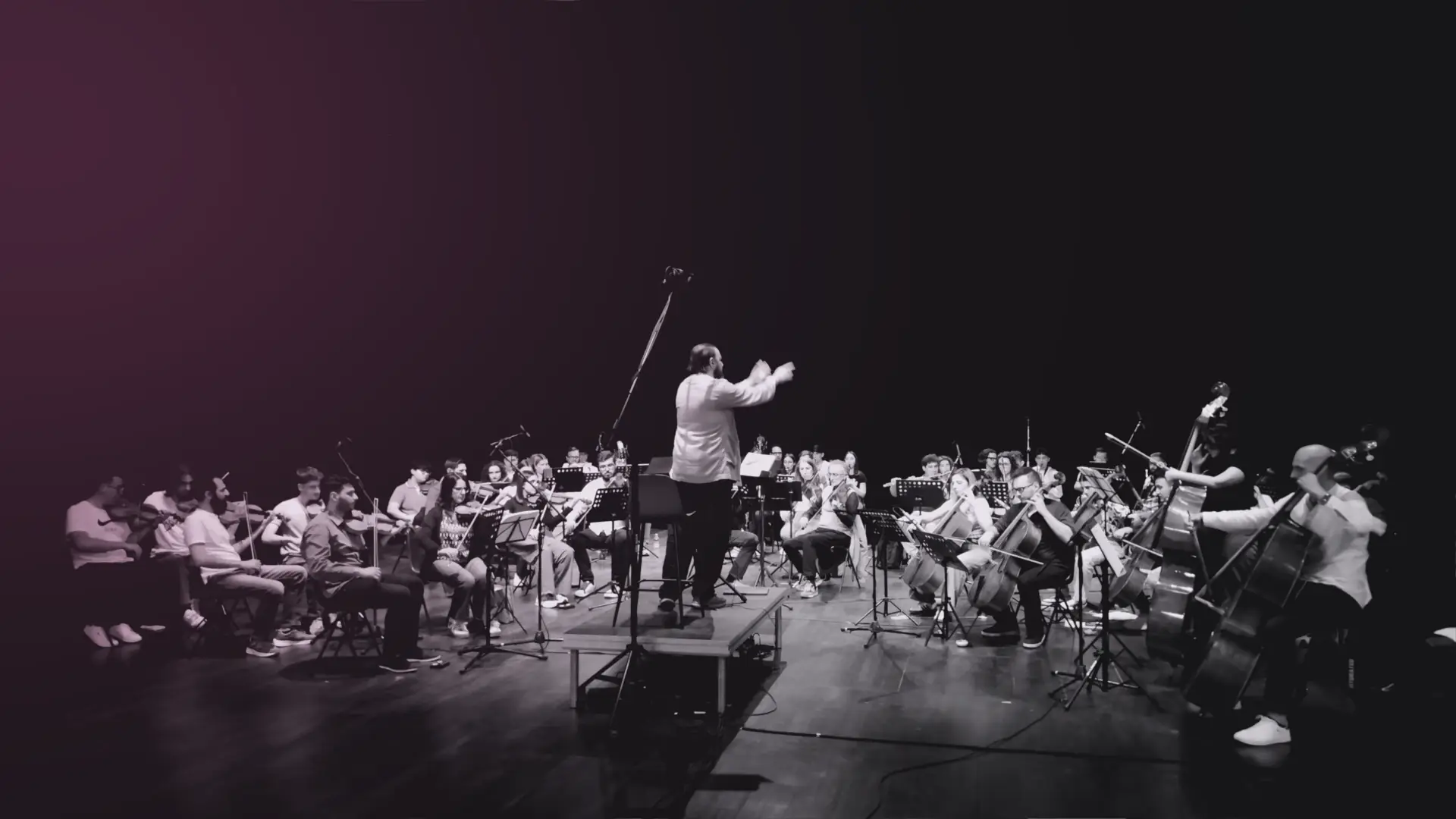
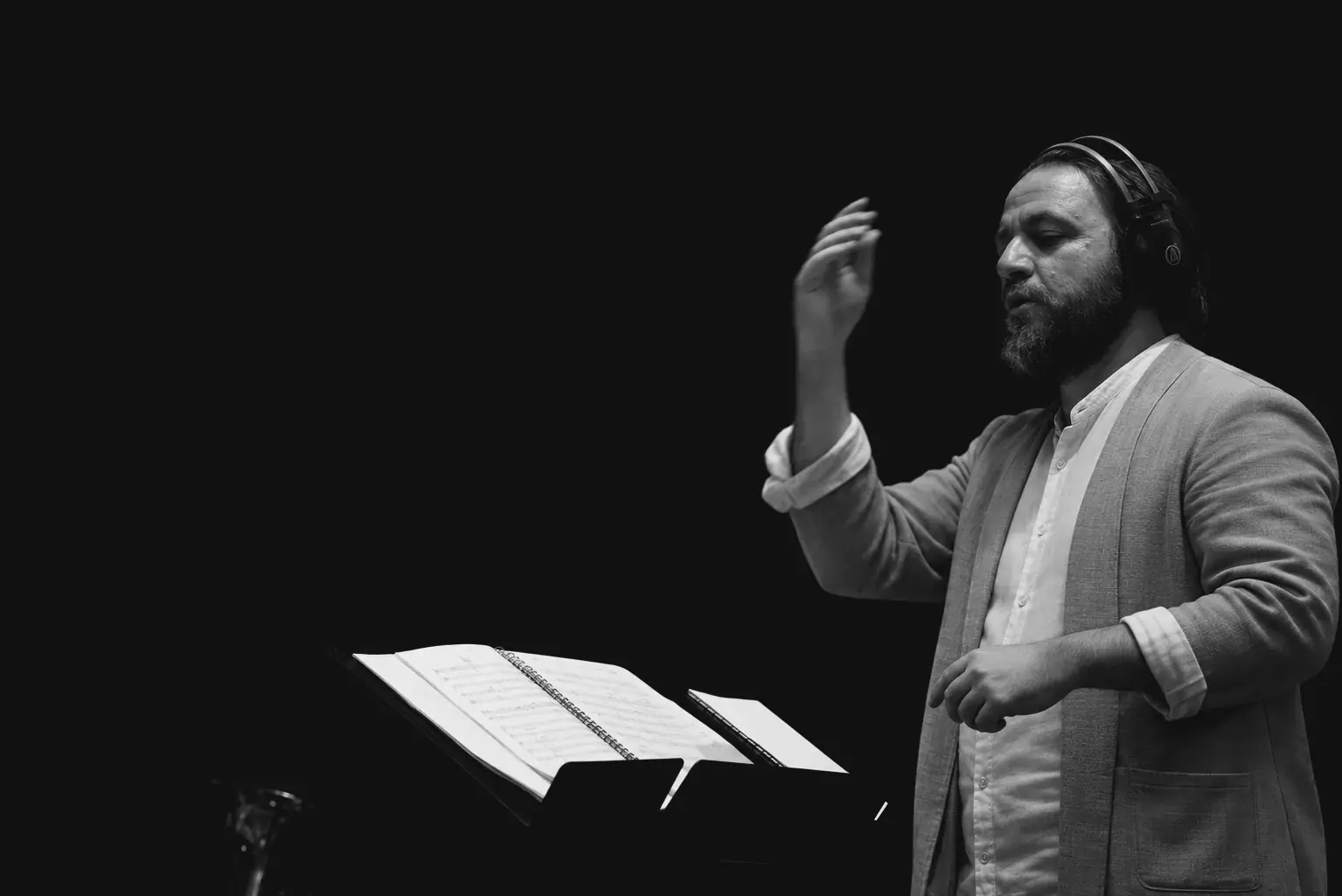
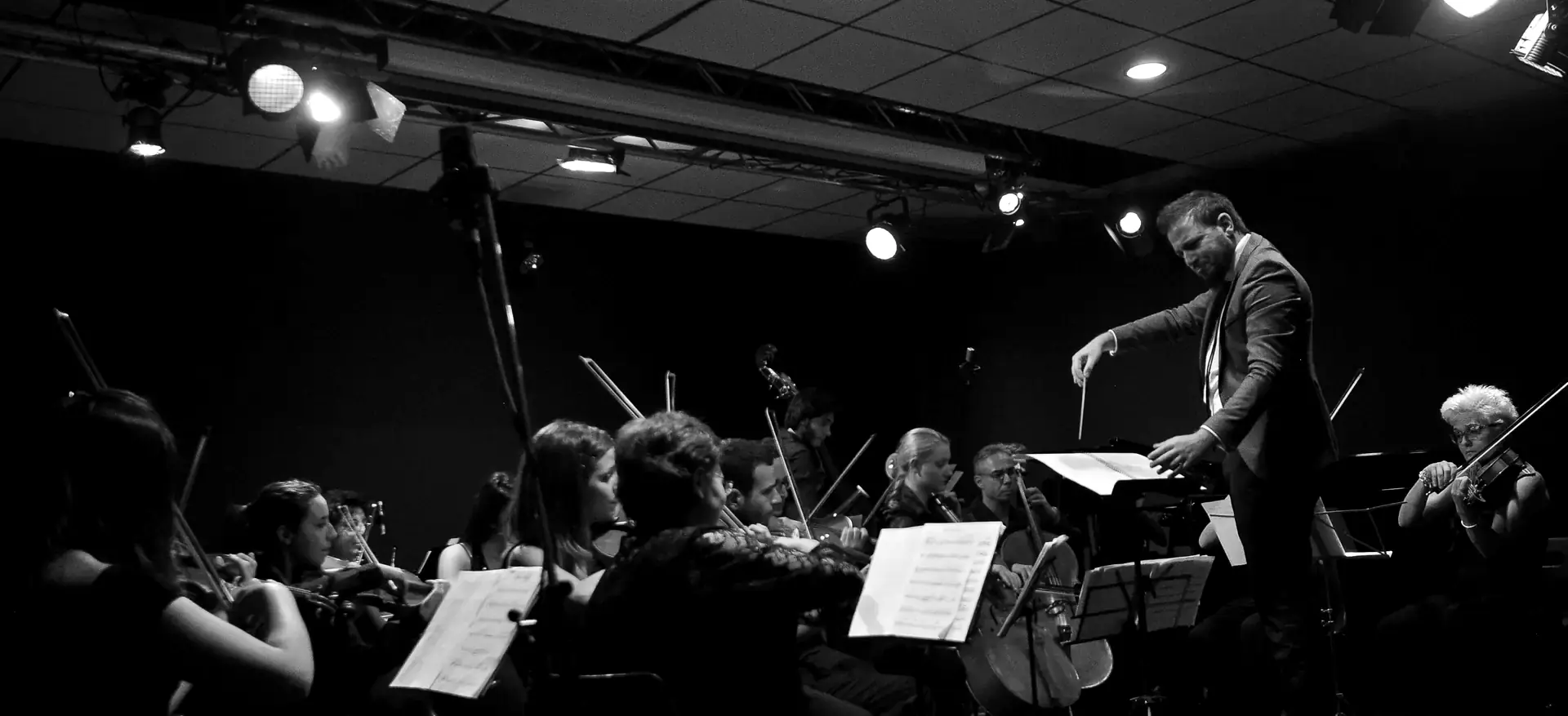
Franco Eco is a film composer, stage director and artistic director. He has written more than 50 scores for films and documentaries for productions in Italy, the United States, Australia, Ukraine and the Philippines, and he is a member of the European Film Academy.
Film composer · Stage director · Artistic director
In brief
Franco Eco (Crotone, Italy, 1984) is an eclectic composer for film and television, a record producer and a member of the European Film Academy. Regarded as one of the most prolific Italian film composers of his generation, he has written the music for more than fifty films and documentaries. He has worked mainly in Italy and has collaborated on productions from the United States, Australia, Ukraine and the Philippines.
Training and influences
In the early 2000s, while studying at the University of Bologna, he was a student of Luciano Nanni and Giuliano Scabia, both linked to Gruppo 63, the Italian neo-avant-garde movement. His teachers also include the theatre masters Emanuele Montagna, Glauco Mauri and Gabriele Lavia. He studied composition with Gianluca Podio at the Saint Louis College of Music in Rome. This multidisciplinary background shaped his interest in the dramaturgy of sound and in the role of music in cinematic storytelling.
Albums and productions
He made his debut in 2009 with Dante Concert, an album devoted to the characters of Dante's Divine Comedy, with a foreword by former Italian Prime Minister Giulio Andreotti. As a record producer he works with artists from all over the world. He produced and arranged the Italian-Ukrainian version of Povera patria by the late Italian songwriter Franco Battiato, performed by Antonella Ruggiero and the Ukrainian artist Oleksandr Iarmola. His productions also include The Bassman by Daniel Sam, Tra cielo e mare by Chiara Ranieri, a former contestant on X Factor Italy, and the debut EP of Martinico, a singer-songwriter and TikTok creator. For the Calabrian folk orchestra Malutempu he produced Mala tempora currunt and Farchinoria.
Film, television and recognition
He composed the music for the documentary on the canonisation of Popes John XXIII and John Paul II, produced by the Vatican Television Centre and Sky and narrated by Giancarlo Giannini. He contributed to the music of Viaggio nei Fori, the multimedia journey created by Piero Angela for the Forum of Augustus in Rome. The soundtrack of The Correspondence includes one of his compositions, chosen by Giuseppe Tornatore and Ennio Morricone.
In 2019 he was nominated for the Globo d'Oro, the award of the Foreign Press in Italy, for the score of Il bene mio. In 2022 he received an honorary diploma from the Scuola di Teatro Colli in Bologna, presented by the Mayor of Bologna, Matteo Lepore. In 2024 the Italian daily il manifesto named Mala tempora currunt among the best albums of the year. In 2026 he won the Premio MUSA, awarded by Italian film music critics, for best documentary score with Hadar – Il frutto di Dio. He sits on the board of ACMF, the Italian association of film music composers, and directs the Festival della Colonna Sonora, a festival devoted to film music.
Theatre and exhibitions
As a stage director he has staged works by Shakespeare, Beckett, Albee and Pinter. He directed and scored Il colore del sole, based on the work of Andrea Camilleri, which premiered at Milan's Piccolo Teatro Grassi in 2016. He conceived two exhibitions devoted to Nobel laureate Dario Fo: Dal disegno alla scena (From Drawing to Stage) at the Pythagoras Museum in Crotone, and La Bibbia dei villani (The Peasants' Bible: Images of a Popular God) at Santa Severina Castle. He curated XXV Ora – Images against Femicide, created with Milan's Brera Academy of Fine Arts. In collaboration with Roma Tre University, he was artistic director of the exhibition Pirandello disegnava (Pirandello Drew: Chaos between the Lines) at Santa Severina Castle.
Diplomacy, teaching and research
From 2017 to 2020 he served as cultural attaché at the Embassy of Benin in Italy, managing relations with Italian and European institutions. He studied cultural policy at the School of Civic Service founded by former Mayor of Rome Francesco Rutelli. He has given masterclasses on film music in Italy and abroad, including Los Angeles, Kyiv, Manila, Cotonou and Khartoum. He designs training programmes on teaching music for the moving image and serves as their scientific director; among them is Ascoltare il cinema (Listening to Cinema), supported by the Italian Ministry of Education and Merit and the Italian Ministry of Culture. Alongside this work he pursues research in musical palaeoanthropology, on the origins of music and the possible role of sound in the development of symbolic thought.